WELL CARE research results presented at the 2nd Global Person Centred Care conference in Gothenburg
Researchers from the WELL CARE project presented ongoing work aimed at strengthening the mental wellbeing and resilience of informal carers and long-term care (LTC) workers during the second Global Conference on Person-Centred Care (GCPCC).
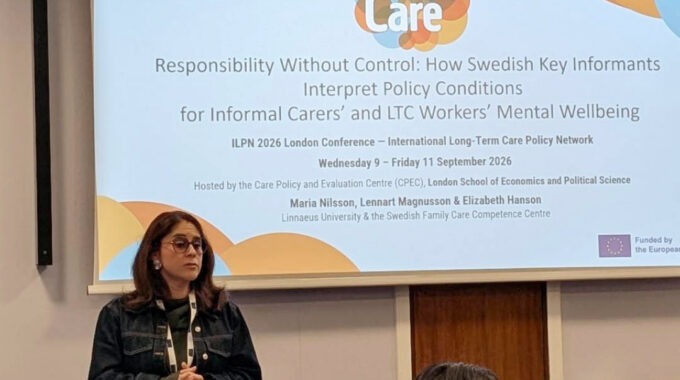
Maria Nilsson (Nka) presented an overview of the WELL CARE project, and findings from Swedish policy interviews (WP4) that showed a need for increased coordination between local and national actors, while also identifying both challenges and opportunities within Sweden’s decentralized governance system. Elin-Sofie Forsgärde (LNU), presented the systematic literature review (WP2) and expert interviews across five partner countries- work that was led by INRCA- the National Institute of Health and Science on Ageing in Italy, which identified 170 good practices to support mental wellbeing, resilience, and care partnership in LTC, with a focus on the top selected 40 good practices. These findings now form the inspiration for the co-creation and testing of 10 local solution prototypes across the five project partner countries of Germany, Italy the Netherlands, Slovenia and Sweden.
The conference brought together 470 participants from 6 continents and 27 countries, including 27 patient and informal carer representative organisations. Other stakeholders represented were health and social care workers, managers, policy makers and researchers. Several presentations during the conference highlighted perspectives relevant to the WELL CARE project, for example:
- Keynote speaker Professor Erna Haraldsdottir (Queen Margaret University, UK) emphasised the existential dimensions of implementing new practices, describing change as a movement into the unknown that can create anxiety while established routines shape what is perceived as valid knowledge. She highlighted the importance of psychological safety, addressing relational and contextual tensions, and combining conceptual anchoring with practical evidence to support successful implementation.
- Michelle Marcinow, PhD (Trillium Health Partners, Canada) presented practical aspects of implementation practice. She emphasised the importance of collaboration between patients, families, staff, and leadership throughout the implementation process, learning together, and ensuring accountability by providing feedback to those who contribute with their experiences. Shared expectations, capacity building, and embedding accountability into everyday practice were highlighted as essential for sustaining implementation work overtime.
- PhD student Rouven Brenner (Eastern Switzerland University of Applied Sciences) presented a study on relatives’ experiences within residential care, showing how relatives are an integral part of care relationships while simultaneously experiencing ambiguity and “in-betweenness” in their role. The study highlighted how relationships are continuously co-created between relatives, residents, and staff.
All abstracts from the conference are available in the Book of Abstracts (PDF).