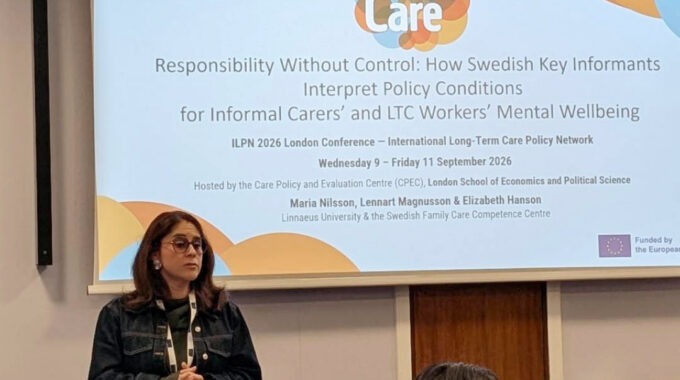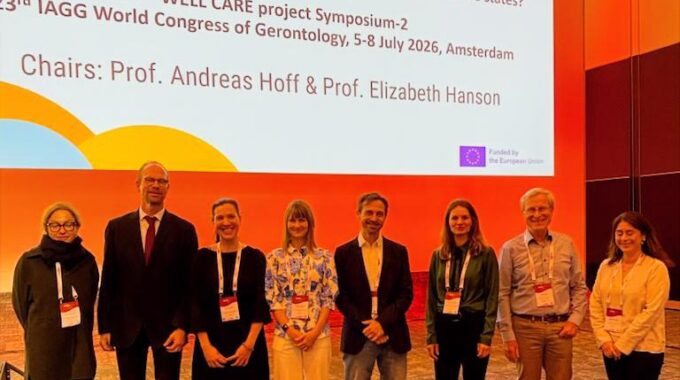
WELL CARE Symposium 2, at the 23rd IAGG World Congress of Gerontology, Amsterdam, 5-8 July
What does long-term care policy do to the people who actually provide care?
That question was at the heart of our second WELL CARE symposium at the 23rd IAGG World Congress of Gerontology: How do long-term care policies and care regimes impact on the mental wellbeing of informal and formal carers in five European welfare states?
Chaired by Andreas Hoff (Zittau/Görlitz University of Applied Sciences), the session opened with Maria Nilsson (Linnaeus University, Swedish Family Care Competence Centre) presenting an overview of the WELL CARE project and its policy analysis work.
Country profiles from Sweden (Maria Nilsson), Germany (Katja Knauthe, Zittau/Görlitz University), Italy (Marco Socci and Beatrice Ietto, INRCA), the Netherlands (Henk Nies, Vrije Universiteit Amsterdam) and Slovenia (Ana Ramovš, Anton Trstenjak Institute, and Miriam Hurtado-Monarres, University of Ljubljana) told strikingly convergent stories. Whether built on universal public services, social insurance or family-based care, all five welfare states lean on informal carers and on a care workforce under growing pressure. The conclusion was shared: the mental wellbeing of informal carers and long-term care workers is not an add-on to long-term care policy but a condition for the sustainability of these systems — and carers have a right to wellbeing in their own right.
WELL CARE is funded by the EU’s Horizon Europe programme (2024–2027) and led by principal investigator Elizabeth Hanson (Linnaeus University).
The country profiles from part of a dedicated report, “Country profiles”, available at WELL CARE’s dedicated website: https://wellcare-project.eu/
Text: Maria Nilsson, Elizabeth Hanson, Swedish Family Care Competence Centre, Linnaeus University, Sweden.