ERWG 2026: putting the spotlight on the hidden value of informal care
The 12th annual gathering of Eurocarers’ Research Working Group (ERWG) took place on 16 and 17 September 2026 in Krakow (Poland), co-hosted and co-organised with the Institute of Sociology and the Center for Evaluation and Analysis of Public Policies of the Jagiellonian University.
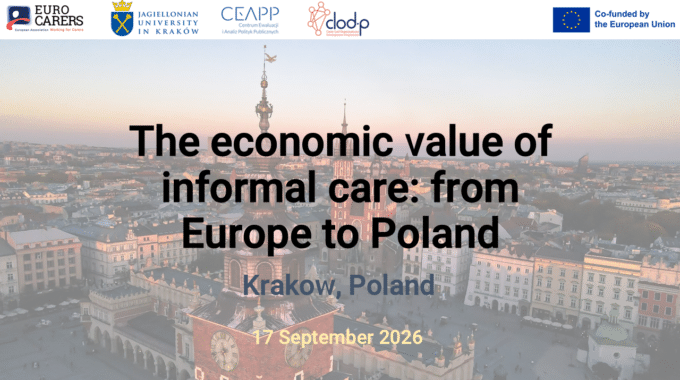
The annual ERWG meeting (16 September) was followed by an international conference (17 September) titled “The economic value of informal care: from Europe to Poland”, organised within the context of Eurocarers’ Carer-Led Organisations Development (CLOD) Programme.
The ERWG meeting traditionally serves as a vital platform to shape the research themes for the year ahead. This year we focused on gender and social inequalities that underpin the hidden value of informal care, a topic that will be of particular relevance for Eurocarers thourghout 2027.
Key messages
Some key messages emerged from this two-day exchange, that will be developed further in Eurocarers’ upcoming work on the topic:
📌 Unpaid care remains structurally overlooked in European economic systems. It is not properly reflected in national accounts, leaving informal carers with weaker pension and social protection outcomes.
📌 We should move beyond simply accounting for the economic value of care and emphasise the the hidden value of care as a whole, highlighting the social, political, cultural, and intrinsic value of care.
📌 People are more essential than figures. Quantifying the monetary value of unpaid care is a powerful tool for making its scale visible to policymakers and to society in general. However, it has to be linked to carers’ own voices and lived experiences to avoid reducing care to numbers and flattening its social value.
Content of the Conference
The conference was structured around two sessions:
Session 1 – The contribution of informal care to the economy
– Presentations to set the scene of the discussion
- Keynote on informal care and the economy: Prof. Anna Zachorowska-Mazurkiewicz (Jagiellonian University, Poland) ‘The Invisible Foundation of the Economy: Theoretical and Empirical Insights’
- Polish perspective: Dominika Janiszewska-Kajka (Deputy Director of the Department of Analysis and Strategy at the Ministry of Health, Poland) ‘Informal care in the context of long-term care reform’
– Perspectives from other countries, drawing from the expertise of Eurocarers Research Working Group:
- Dr Nikki Dunne (Family Carers Ireland, Ireland) ‘Estimating the economiccontribution of family carers: The Irish context’
- Primoz Skrt (Acufade, Spain) ‘The care we don’t count holds everything up. Measuring 343 million hours of unpaid long-term care in the Canary Islands —and what Canary Islands, Spain and Europe should learn from it’
- Dr Emma Miller (Coalition of Carers in Scotland, UK) ‘Time use diaries and valuing unpaid care’
Session 2 – Economic challenges: carers are paying the price of long-term care
– Perspectives drawing from the expertise of Eurocarers Research Working Group:
- Dr Georgia Casanova (INRCA, Italy) ‘From the economic value of informal care to the economic vulnerability of caregivers Evidence from the SEreDIPE Marie Skłodowska-Curie project’
- Dr Maria Petrillo (Centre for Care, UK) ‘Estimating the Cost of Informal Care with a Novel Two-Stage Approach to Individual Synthetic Control’
- Prof. Andreas Hoff (GAT Institute, Zittau/Goerlitz University, Germany) ‘The MonetaryValue ofInformal Care in Germany’
Get in touch
If you would like to know more about the work of the Eurocarers Research Working Group, or have any questions about the 2026 meeting, you can contact Giulia Lanfredi at gl@eurocarers.org
If you would like to know more about the Eurocarers’ Carer-Led Organisations Development (CLOD) Programme, you can contact Andrea Sanchez Caballero at as@eurocarers.org