The Story of a Family Living with Dementia – A Simulation
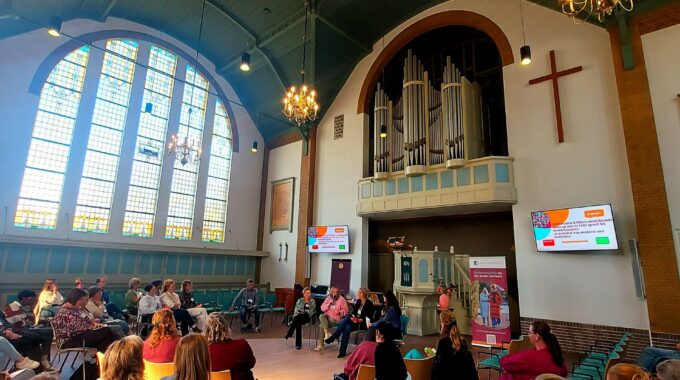
Our Greek colleagues from the Hellenic Alzheimer’s Association and Related Disorders conducted an experiential workshop “The Story of a Family Living with Dementia” which integrates systemic psychodrama techniques—such as simulation and role reversal—within a structured group setting.
Family members of people living with dementia frequently experience a range of negative emotions directed toward the affected relative as well as toward other caregivers. These reactions often stem from the belief that each caregiver is acting to the best of their ability based on personal experience. As the condition progresses, established communication patterns and relational structures within the family system become destabilized, leading to the adoption of maladaptive or dysfunctional problem-solving strategies. Consequently, the inherent burden of the disease is further exacerbated by the deterioration of interpersonal relationships among caregivers.
The experiential workshop “The Story of a Family Living with Dementia” integrates systemic psychodrama techniques—such as simulation and role reversal—within a structured group setting. Participants are presented with a scenario depicting a family in which one member has been diagnosed with dementia. They are then divided into groups, with each group assigned to articulate the cognitive, emotional, and behavioral perspective of a particular family member, including the person with dementia. Each group becomes the “voice” of its designated protagonist (e.g., the daughter, the son, their mother with dementia , or the home-care worker).
Through this immersive process, participants are encouraged to step into the subjective experience of each family member and to understand how individuals negotiate their roles and relationships within the context of dementia. Following the group preparation phase, a representative from each group enacts the voice of their respective family member, engaging in a facilitated, simulated dialogue among the protagonists. This enactment enables the audience to experientially engage with the familial roles and to recognize the complexities, tensions, and relational disruptions that dementia generates within the family system.
Ultimately, the audience becomes an active participant in the simulation, allowing crucial family dynamics, potential areas of conflict, and viable strategies for conflict resolution and problem management to emerge organically. The exercise is designed to shift participants away from their own subjective viewpoints and toward a deeper, embodied understanding of the lived experience of families coping with dementia. In doing so, it aims to cultivate empathy, enhance systemic awareness, and promote more constructive dialogue among caregivers, mental-health professionals, and dementia-care practitioners.
Maria Toumpalidou, Psychologist–Psychotherapist
Hellenic Alzheimer’s Association and Related Disorders – Caregivers’ Unit / Family Therapy
Email: matoumpalidou@yahoo.gr
Maria Egkiazarova, Psychologist–Psychotherapist
Hellenic Alzheimer’s Association and Related Disorders – Caregivers’ Unit / Family Therapy
Email: maria_egkiaz@hotmail.com